.svg)


Apostille vs. Embassy Legalization: Which Do You Need?

January 27, 2026
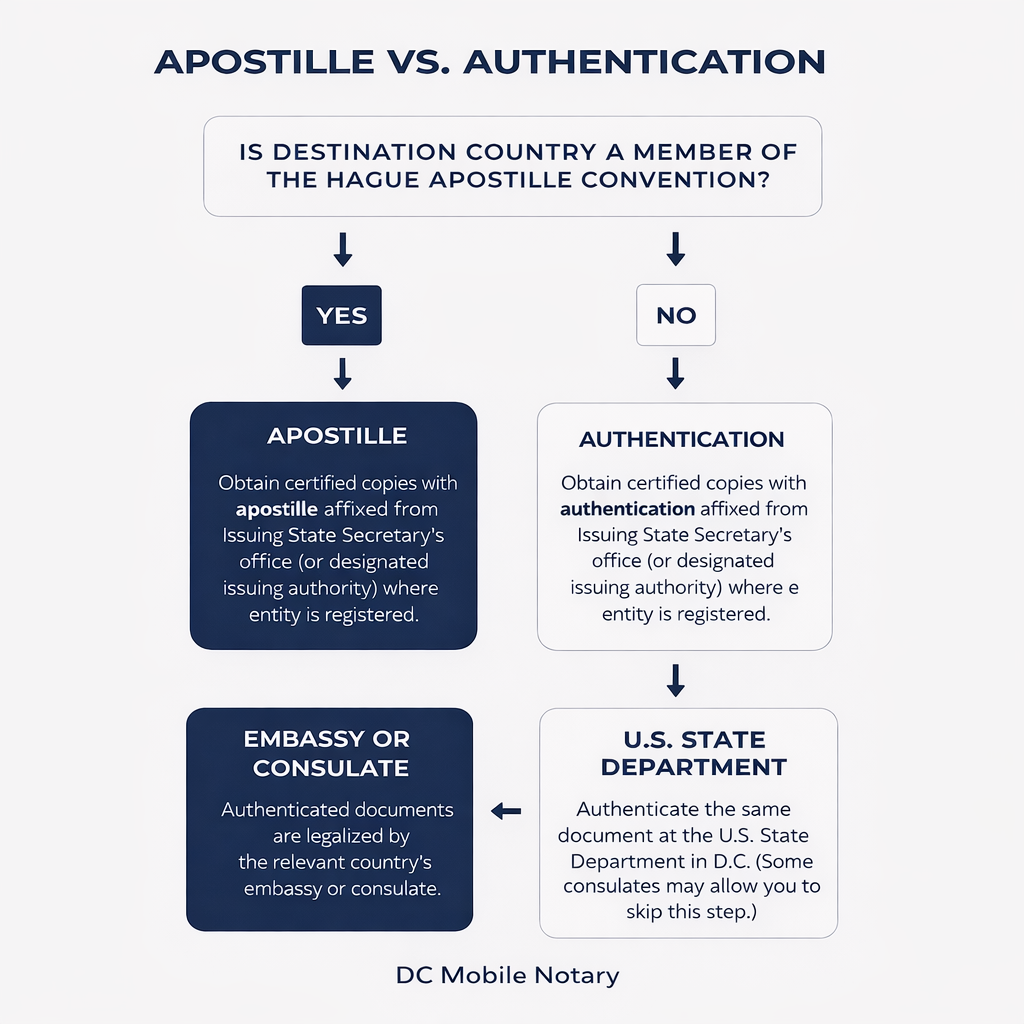
Apostille vs. Embassy Legalization: Which Do You Need?
If you’ve been told you need an apostille or embassy legalization for your documents but no one has clearly explained the difference, you’re not alone.
At DC Mobile Notary, we speak with clients every day who are confused, overwhelmed, and worried about submitting the wrong type of authentication. Unfortunately, choosing incorrectly can lead to rejected documents, missed deadlines, and costly delays.
This guide clearly explains the difference between apostille vs. embassy legalization, how the Hague Convention affects your documents, and how to determine the exact service you need — before you waste time or money.
Quick answer:
- Hague Convention country → Apostille
- Non-Hague country → Embassy legalization
Let’s break it down clearly.
What Is an Apostille?
An apostille is an official certificate that authenticates the origin of a public document so it can be legally recognized in another country.
The apostille process exists because of the 1961 Hague Apostille Convention, an international treaty created to simplify document authentication between member countries.
Instead of going through embassies and consulates, documents for Hague countries require only one form of authentication — the apostille.
Common Documents That Require an Apostille
- Birth certificates
- Marriage certificates
- Divorce decrees
- Diplomas and academic transcripts
- Power of Attorney documents
- FBI background checks
- Corporate and business records
Where Apostilles Are Accepted
Apostilles are recognized in over 120 countries, including many in Europe, Asia, and Latin America.
If your destination country is part of the Hague Convention, embassy legalization is not required.
To verify whether your destination country is a Hague Apostille country, you can check the official Hague Conference on Private International Law (HCCH) authority list directly here: https://www.hcch.net/en/instruments/conventions/authorities1/?cid=41
If the country does not appear on that list, your documents will require full embassy legalization instead of an apostille.
What Is Embassy Legalization?
Embassy legalization (also called consular legalization or embassy attestation) is required when the destination country is not a member of the Hague Convention.
Because there is no treaty-based recognition, documents must go through multiple layers of government authentication before they are accepted abroad.
Embassy Legalization Typically Involves:
- Proper notarization (if required)
- State-level authentication
- U.S. Department of State authentication
- Legalization by the destination country’s embassy or consulate
Each step must be completed in the correct order. Skipping or misplacing a step will result in rejection.
This is why embassy legalization is more complex — and why professional handling matters.
Submitting an apostille for a non-Hague country will result in rejection.
How Do You Know Which One You Need?
Ask yourself one simple question:
Is the destination country part of the Hague Apostille Convention?
- Yes → Apostille
- No → Embassy legalization
If you’re unsure, DC Mobile Notary verifies the country requirements before processing anything, using official government and embassy guidance.
Non-Hague Countries That Require Embassy Legalization
If your destination country appears below, an apostille alone will NOT be accepted.
Non-Hague Countries Include:
Afghanistan, Algeria, Angola, Benin, Burkina Faso, Burma (Myanmar), Cambodia, Cameroon, Congo (Democratic Republic), Congo (Republic), Cuba, Egypt, Eritrea, Ethiopia, Ghana, Guinea, Haiti, Iran, Iraq, Ivory Coast, Jamaica, Jordan, Kenya, Kuwait, Laos, Lebanon, Libya, Macedonia, Madagascar, Malaysia, Mali, Mauritania, Mozambique, Nepal, Niger, Nigeria, Palestine, Qatar, Sierra Leone, Sri Lanka, Sudan, Syria, Taiwan, Tanzania, Thailand, Togo, Turkmenistan, United Arab Emirates (UAE), Uganda, Vietnam, Yemen, Zambia, Zimbabwe.
Important Tip:
If the destination country is not listed above and is a Hague Convention country, then only an apostille is required.
Why Embassy Legalization Errors Are Common
Embassy legalization fails most often due to:
- Incorrect notarization
- Missing state authentication
- Skipping U.S. Department of State authentication
- Embassy-specific formatting errors
- Using mail-only companies unfamiliar with embassy rules
These mistakes frequently cause weeks or months of delays — or permanent rejection.
Embassy Legalization: Why Choose DC Mobile Notary
DC Mobile Notary is based in Washington, DC, giving us direct access to embassies, the U.S. Department of State, and federal authentication offices.
How We Handle Embassy Legalization
- No middlemen — all work handled in-house
- Over 10 years of embassy legalization experience
- One dedicated agent per client from start to finish
- Free document review before payment
- Faster processing than mail-only services
- Email updates and tracking for transparency
- Full refund guarantee if we do not deliver
This level of control dramatically reduces rejection risk.
Apostille & Embassy Legalization for FBI Background Checks
FBI background checks are one of the most commonly rejected documents when handled incorrectly.
- Hague country → Apostille issued by the U.S. Department of State
- Non-Hague country → Full embassy legalization
DC Mobile Notary manages both federal authentication and embassy submission, ensuring compliance at every step.
Final Answer: Apostille or Embassy Legalization?
Here’s the simplest and most accurate rule:
- Hague Convention country → Apostille
- Non-Hague country → Embassy legalization
If you’re unsure, don’t guess.
DC Mobile Notary offers free document review to confirm the correct process before you pay.
Get It Done Right the First Time
International document authentication is not forgiving — but it is manageable with the right partner.
DC Mobile Notary ensures your documents are:
- Properly authenticated
- Government compliant
- Embassy accepted
- Tracked from start to finish
Need Help? Contact DC Mobile Notary
We are based in Washington, DC right next to the U.S. Department of State and the embassies, which means your documents are handled at the source. This ensures faster processing, secure handling, and fewer delays compared to mailing them elsewhere. Whether you ship your documents from anywhere in the U.S. or visit us in person, our team will take care of the entire embassy legalization process quickly and hassle-free.
Click here https://www.dcmobilenotary.com/embassy-legalization-legalization-services to get started
or contact us at 202-770-2601 | support@dcmobilenotary.com.

‹ Previous
Next ›
Mobile Live Scan Fingerprinting in DC, Virginia and Maryland: We Come to You (2026)
October 20, 2026

FD-258 Fingerprinting in Arlington, VA or Mobile in DC, Northern Virginia and Southern Maryland: Fast, Easy Fingerprint Cards (2026)
October 20, 2026